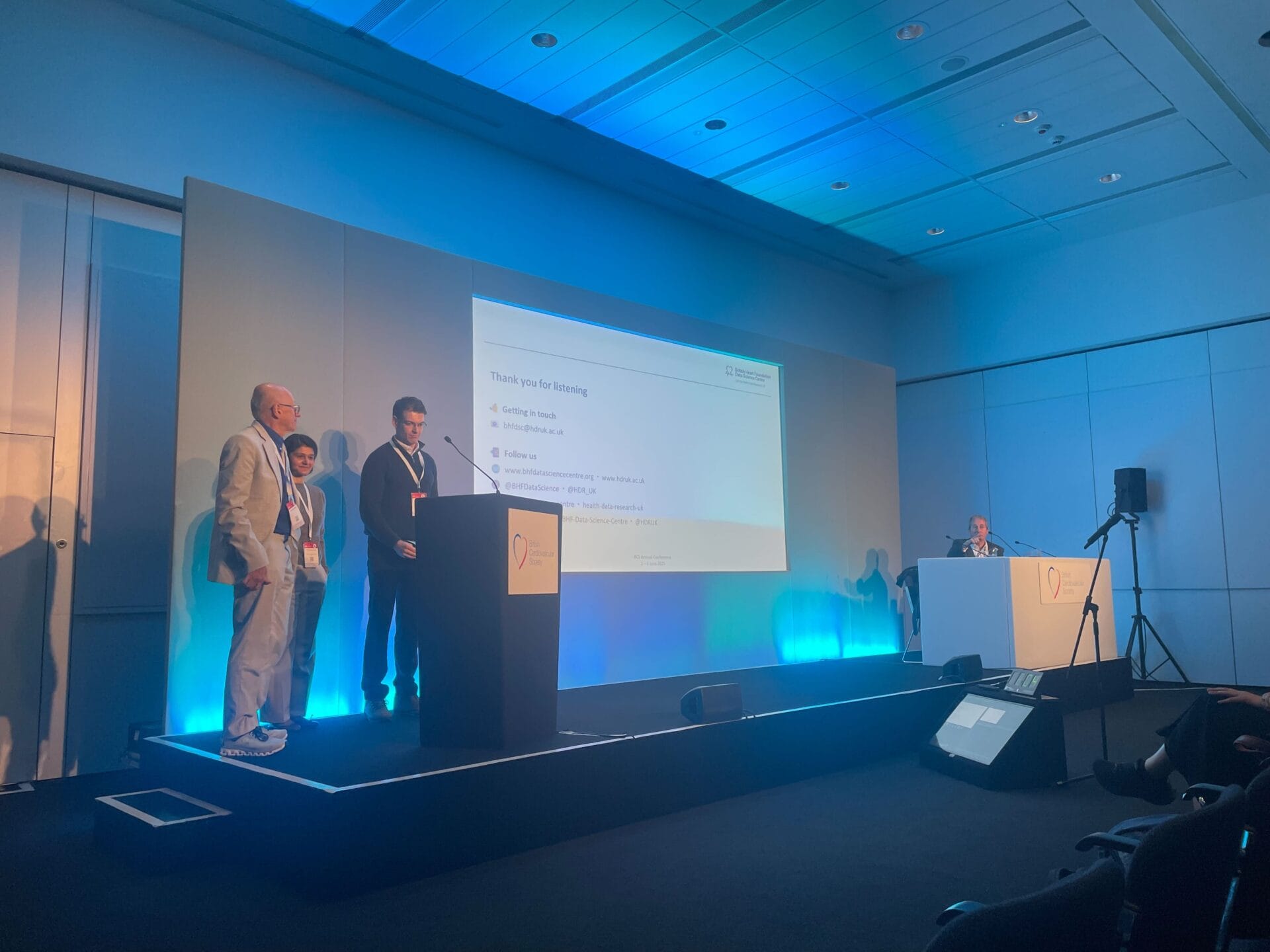
Senior Scientific Programme Manager Dr Jackie MacArthur explains why we held a workshop focusing on health economics, what we found, and what it means for the community.
Cardiovascular disease (CVD) remains one of the leading causes of illness, death, and healthcare expenditure in the UK. Health economics – the field of study that applies economics theories to healthcare in the analysis of costs, benefits, behaviours, and policy impacts – has never been more important, helping to ensure that healthcare resources are used in the most effective, efficient, and equitable way. Yet many of the data, tools, and support systems needed for rigorous, population-scale economic analysis remain difficult to access or are not widely known within the health economics community.
At the British Heart Foundation (BHF) Data Science Centre, we want to change that for the benefit of our society.
Bringing health economists and data scientists together
To better understand how the BHF Data Science Centre can facilitate health economics in cardiovascular research, we held a workshop in May 2025. We invited health economists, health data scientists, clinicians, patients, and representatives from policy and funding organisations. Participants explored opportunities for using large-scale linked health data in economic evaluation of current and future medical practice, as well as the challenges and gaps that currently stand in the way of progress.
A clear message emerged: the BHF Data Science Centre already provides many of the tools, datasets and infrastructure needed for cardiovascular health economics. But awareness of these resources amongst health economics professionals, and their benefits to society, is still limited.
What we learned
Participants identified major opportunities for health economics to drive improvements in cardiovascular prevention, diagnosis and care, from better understanding disease burden to modelling the cost-effectiveness of new interventions and identifying where healthcare systems could be made more efficient.
The workshop also highlighted the value of our existing resources, including population-wide linked datasets, curated research-ready assets, tools and secure environments for large-scale analysis.
In response, we’re now taking forward a number of actions, including raising awareness of the Centre and our resources within the health economics community, exploring collaborative exemplar projects, and developing additional guidance and training.
Professor Andrew Street, London School of Economics, is an expert in health economics, and helped us to organise the workshop. He said:
“What stood out in the workshop is that the BHF Data Science Centre is in a strong position to unlock richer, more realistic economic evaluations in cardiovascular research, but far too few people know these resources exist. By raising awareness, supporting researchers to use large-scale linked health data effectively, and harnessing patient perspectives, we have a real opportunity to accelerate high-quality, patient-centred health economics work across the UK.”
Views of patients and the public
Following the workshop, we gathered further insights from members of our Public Advisory Group. Working with the two patient representatives who participated in the workshop, we co-designed a dedicated session and survey to explore patient and public perspectives on using health data for health economics.
Across the group, there was strong support for using health data in health economics research. Members emphasised the importance of engaging the wider public and improving understanding of how health economics contributes to better care. Highlighting positive and relatable examples of health economics in practice was seen as a useful way to build trust and awareness.
Patients and public contributors also reflected on priority areas where economic analysis can make the greatest impact. These included evaluating new treatments and interventions, strengthening prevention strategies, and identifying improvements in care pathways that deliver both better patient outcomes and cost savings. They stressed the importance of capturing the full economic impact of cardiovascular disease, including effects on patients, families and carers – not only direct NHS costs.
Public contributor Dr Phil Blakelock, who attended the workshop and supported with this work, said:
“There is a burden on the NHS that is now beyond breaking point. There aren’t enough expert medical professionals to service all the needs. The answer is not to get more – ever-growing costs cannot be sustained – but to facilitate their more efficient use.”
Read the full workshop report
We’ve published a detailed report summarising the discussions, findings and recommendations from the workshop, along with additional insights from our patient and public engagement activities.
Read the full report: Supporting Cardiovascular Health Economics: Insights from the BHF Data Science Centre Workshop
Get involved
We’re keen to work with health economists across the UK to shape our future services and make sure our data resources continue to meet the needs of this community.
If you’d like to keep in touch and hear about upcoming activities, please sign up to our newsletter, or reach out to bhfdsc@hdruk.ac.uk.